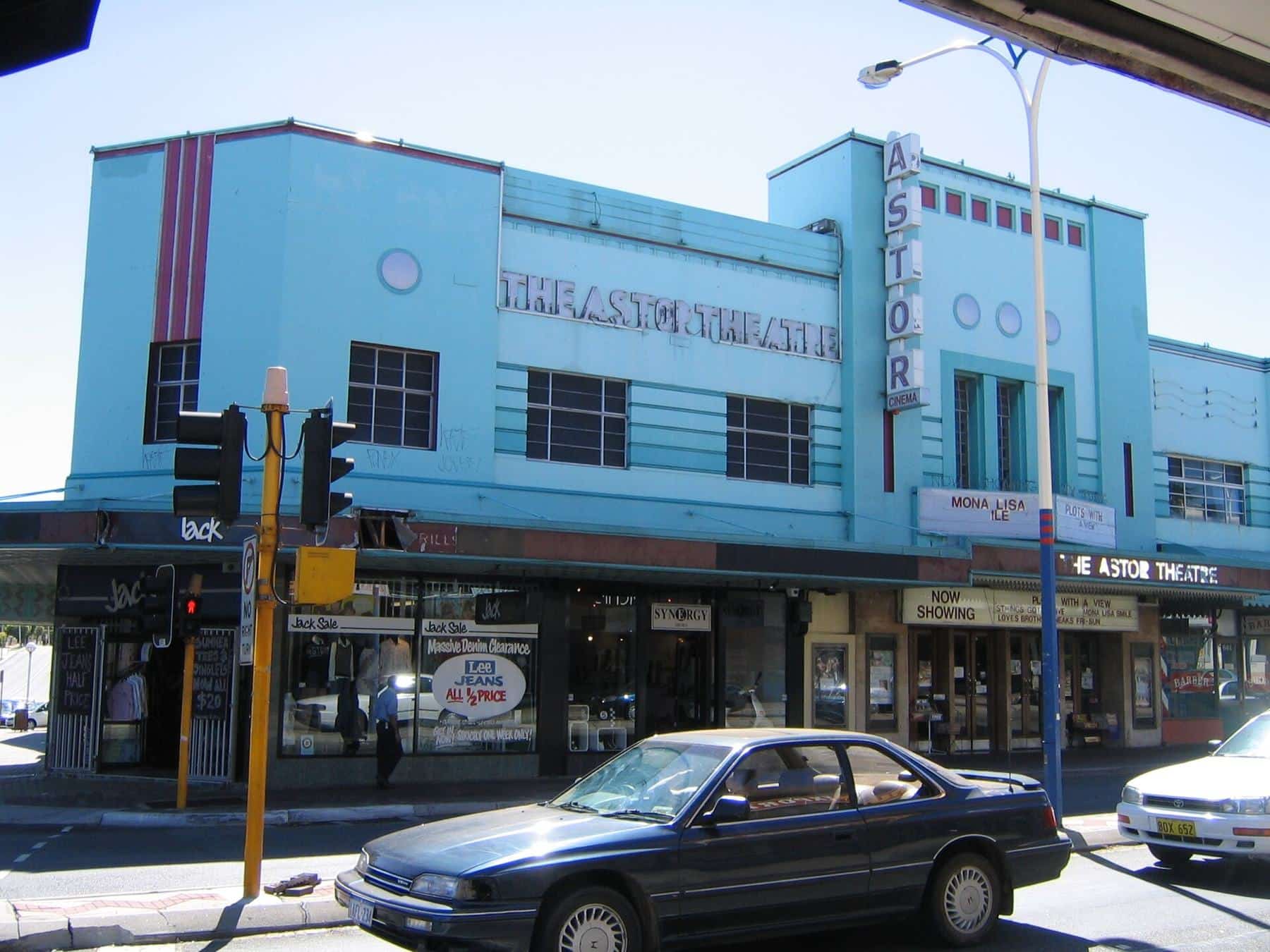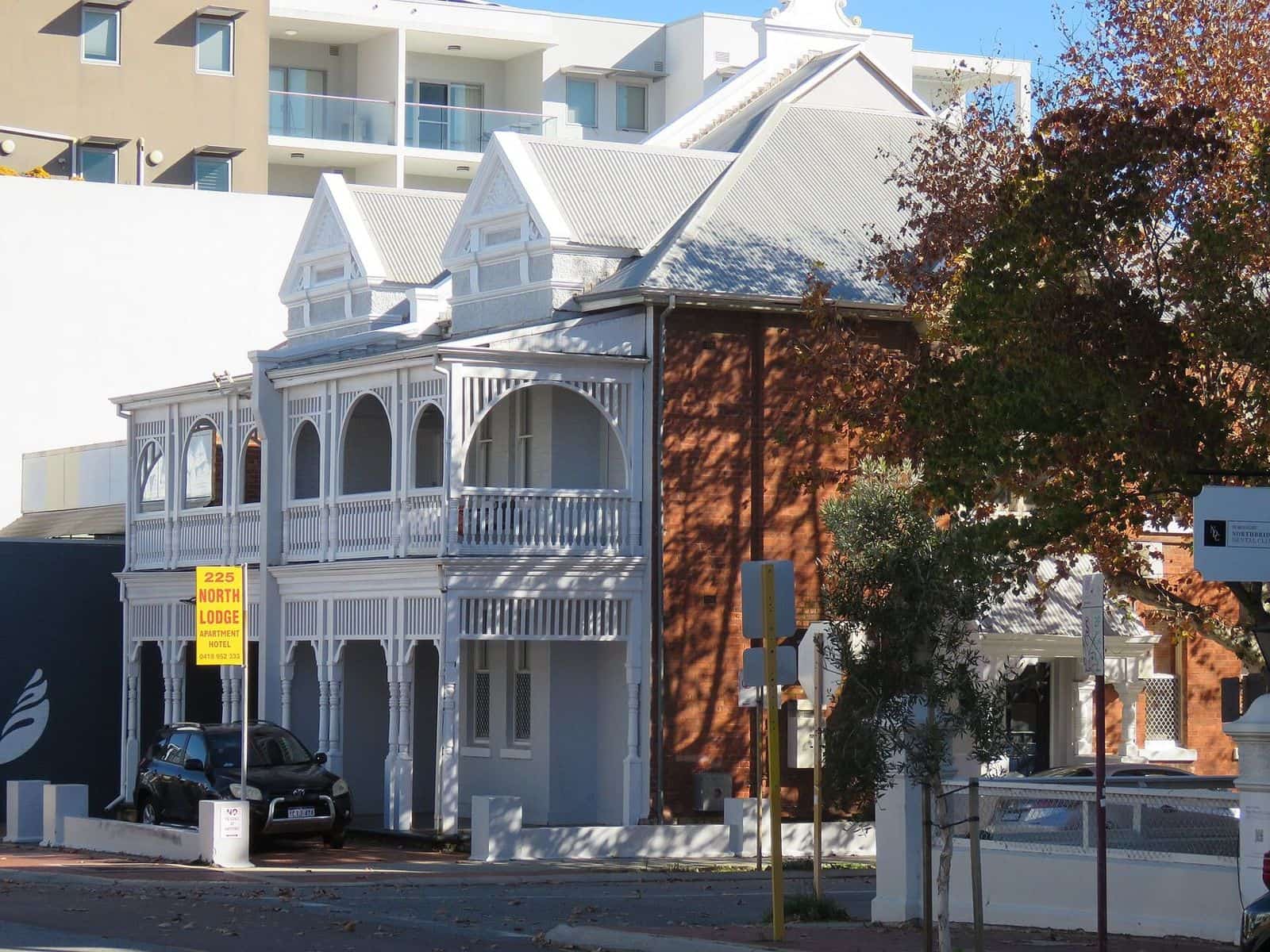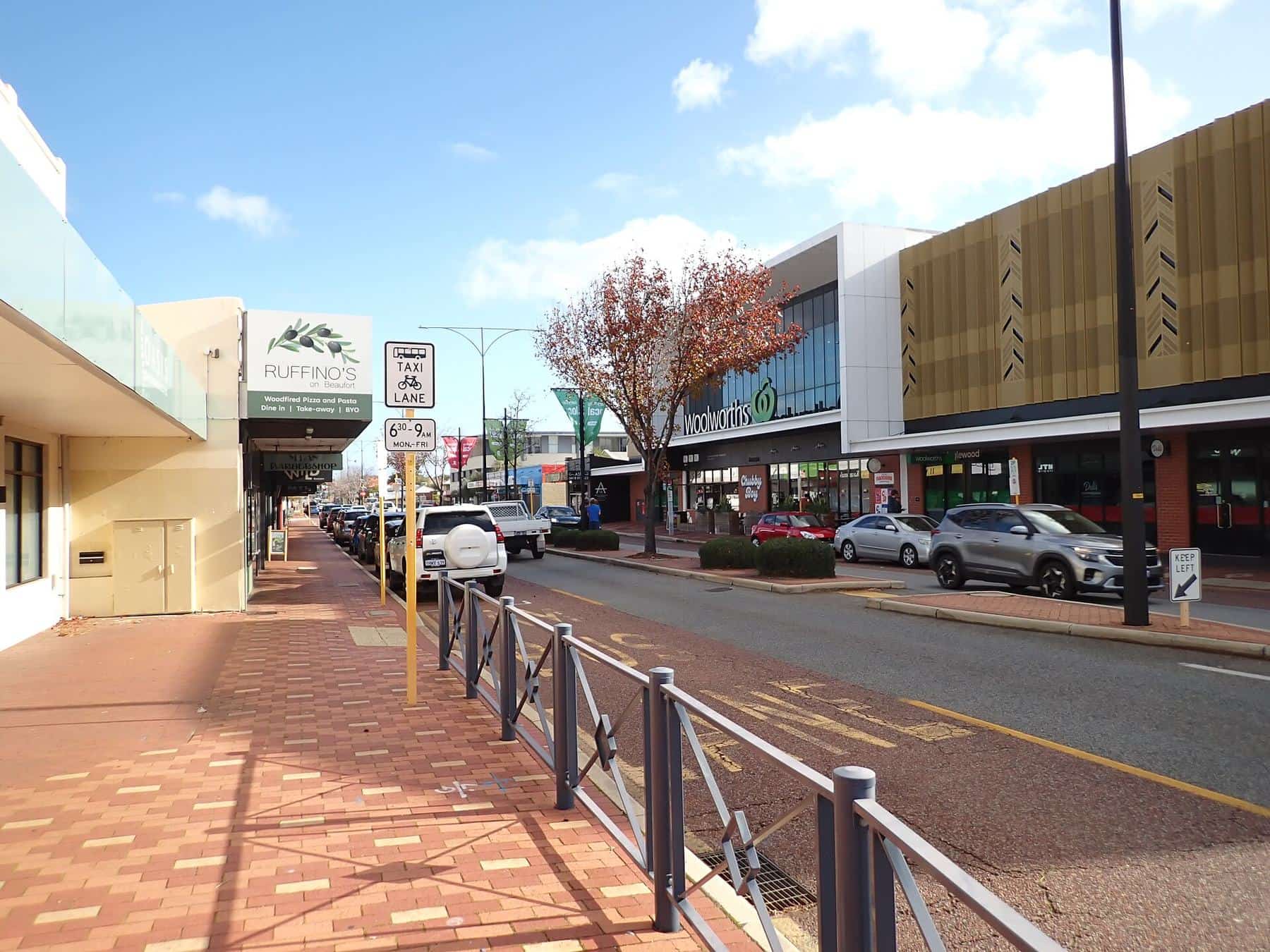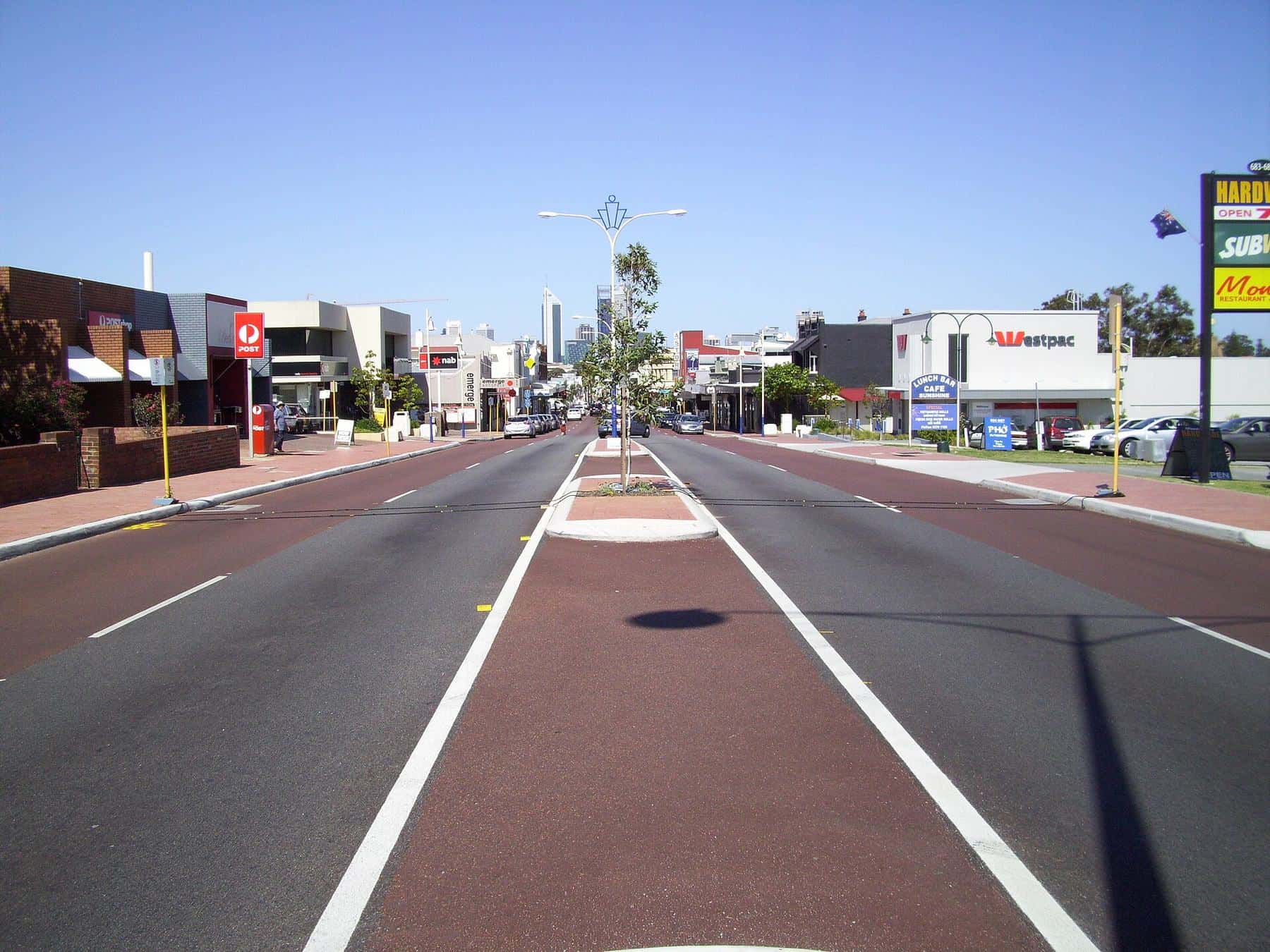
If Beaufort Street has a centre, it is the junction with Walcott Street in Mount Lawley. Here the Astor Theatre’s Art Deco tower faces the 1911 Alexander Building, trams once turned towards Maylands, and the restaurants spill out onto the footpath on warm evenings.
1901
Suburb proclaimed
Named for Governor Arthur Lawley
1911
Alexander Building
Built by S.B. Alexander
1930s
Art Deco era
Flats, shops and the Astor
Noongar country
The City of Vincent notes that the Mount Lawley area contains several Aboriginal cultural heritage sites. The Swan River and the riverside around Banks Reserve were a Noongar meeting place and camp site with a connection to the Waugal, the rainbow serpent that created and protects the waterways. The name Warndoolier appears on early maps of the Banks Reserve area.
From Crown land to suburb
After colonisation, much of the area remained undeveloped. The City of Perth was established in 1871 with its northern boundary at Walcott Street, which is why the street still marks council and suburb boundaries today. The railway from Fremantle to Guildford opened in 1881, and the gold boom of the 1890s triggered subdivision near the railway and along the new tram route up Beaufort Street.
In 1901 Mount Lawley was proclaimed as a suburb, named for Sir Arthur Lawley, Governor of Western Australia from 1901 to 1902. Developers Copley & Robinson subdivided and sold much of the area. By 1906 they had underwritten an extension of the tram along Walcott Street to York Street, and the trams helped business grow along Beaufort Street.
An early landmark was Hallyburton House at 49 Walcott Street, built in 1893. Locals called it "the lighthouse" because the light in its turret could be seen from down the hill in Highgate.
The Alexander buildings
Builder Simon Bremner Alexander shaped the junction. In 1911 he built the two-storey Broadway Building (later the Alexander Building), with shops and residences. Opposite, in 1914–15, he built the Lyceum Building, home to the Lyceum Theatre, which later became the Astor. See our Astor Theatre guide.
Art Deco Mount Lawley
Mount Lawley has a rich Art Deco heritage from the 1930s, when flats, homes and commercial buildings were built in the streamlined style. Look for:
- the Astor Theatre, remodelled in 1939;
- the Clarke Building at 639 Beaufort Street, built in 1934 for William Beattie, who ran a wine saloon. It later traded as a pub under various names;
- the Waihemo Flats at 686 Beaufort Street and the Roslyn Flats at 94 Walcott Street;
- the site of the 1938 Star garage on the south-east corner of Walcott and Beaufort, a sign of the arrival of the motor car;
- the Gothic-style former Forrest Park Methodist Church (1933) at 41 Walcott Street.
Post-war Mount Lawley
After the Second World War, migrants from Italy, Greece, Croatia, Poland and elsewhere in Europe settled in the area, and family businesses lined Beaufort Street. The City of Vincent’s history records the Mount Lawley Frock Shop opened by the Bercove family in 1947, Balshaw’s Florist at 623 Beaufort Street from 1962, and the Bluebird Tearooms at 661 Beaufort Street, run by the Kalaf family from 1954 to 1972.
Revival
The restoration of the Astor in 1989 helped spark Beaufort Street’s revival as an entertainment precinct in the 1990s and 2000s. In 2009 the Beaufort Street Network, Western Australia’s first "town team", was formed to promote the area, and it went on to run the Beaufort Street Festival.
Fenian Crossing and the subway
Where the railway crossed Guildford Road, a dangerous level crossing known as Fenian Crossing, said to be named after the Irish convicts who built it, caused many accidents. The Mount Lawley Subway, a railway bridge, was built in 1907 to fix the problem. In 1924 a tram extension ran through it to Maylands.
Schools and institutions
Mount Lawley Primary School opened on Second Avenue in 1912, and the Anglican girls’ school Perth College moved to Lawley Crescent in 1916. Mount Lawley High School followed in 1955. Forrest Park hosted Norwood State School from 1908, later Forrest Technical High School.
Walking the side streets
Away from Beaufort Street, Mount Lawley’s streets are known for Federation villas, Californian bungalows and Inter-War homes, many carefully restored. A slow walk through the streets east of the strip, towards Queens Crescent and Windsor Hall, shows why the suburb is valued for its heritage character.
Eating and drinking
The blocks either side of Walcott Street are packed with restaurants, bars and cafés. Venues change too often for a list to stay accurate, but expect everything from casual dining to wine bars and late-night spots. Book ahead for Friday and Saturday nights.
Things to do
- See a gig, a comedy show or a film at the Astor.
- Browse the independent shops.
- Walk the side streets to see Federation and Inter-War homes.
- Visit Forrest Park on Walcott Street, a recreation reserve since the early 1900s.
- Follow our walking tour.
Mount Lawley checklist
0 of 6 done
Ticks are saved in this browser only.
Mount Lawley today
According to the City of Vincent, citing the 2021 Census, Mount Lawley across all its councils has just over 11,000 residents. It has a higher share of flats and apartments than the WA average, and a high share of professionals and tertiary-educated residents.
Getting there
Buses run along Beaufort Street through Mount Lawley. Mount Lawley train station, on the Midland line, is on the eastern side of the suburb, a longer walk from Beaufort Street. See getting here.
Next stop
Continue north to Inglewood or back down the hill to Highgate.
Frequently asked questions
Who is Mount Lawley named after?
Sir Arthur Lawley, Governor of Western Australia from 1901 to 1902. The suburb was proclaimed in 1901.
What council is Mount Lawley in?
Mount Lawley spans three councils. The southern part, south of Walcott Street, is in the City of Vincent; other parts are in the City of Stirling and City of Bayswater, and a small section was in the City of Perth.
What are the must-see buildings in Mount Lawley?
The Astor Theatre (659 Beaufort St), the Alexander Building opposite, the 1934 Clarke Building (639 Beaufort St) and the Waihemo Flats (686 Beaufort St).
Is Mount Lawley a good place to go out at night?
Yes. The blocks around Beaufort and Walcott streets are among Perth’s busiest for restaurants, bars and live entertainment, especially from Thursday to Saturday. Book ahead and plan your trip home.
Sources and further reading
Facts on this page were checked against these primary and official sources. Conditions change — confirm before you travel or buy.
- Mount Lawley history — City of Vincent Library & Local History Centre