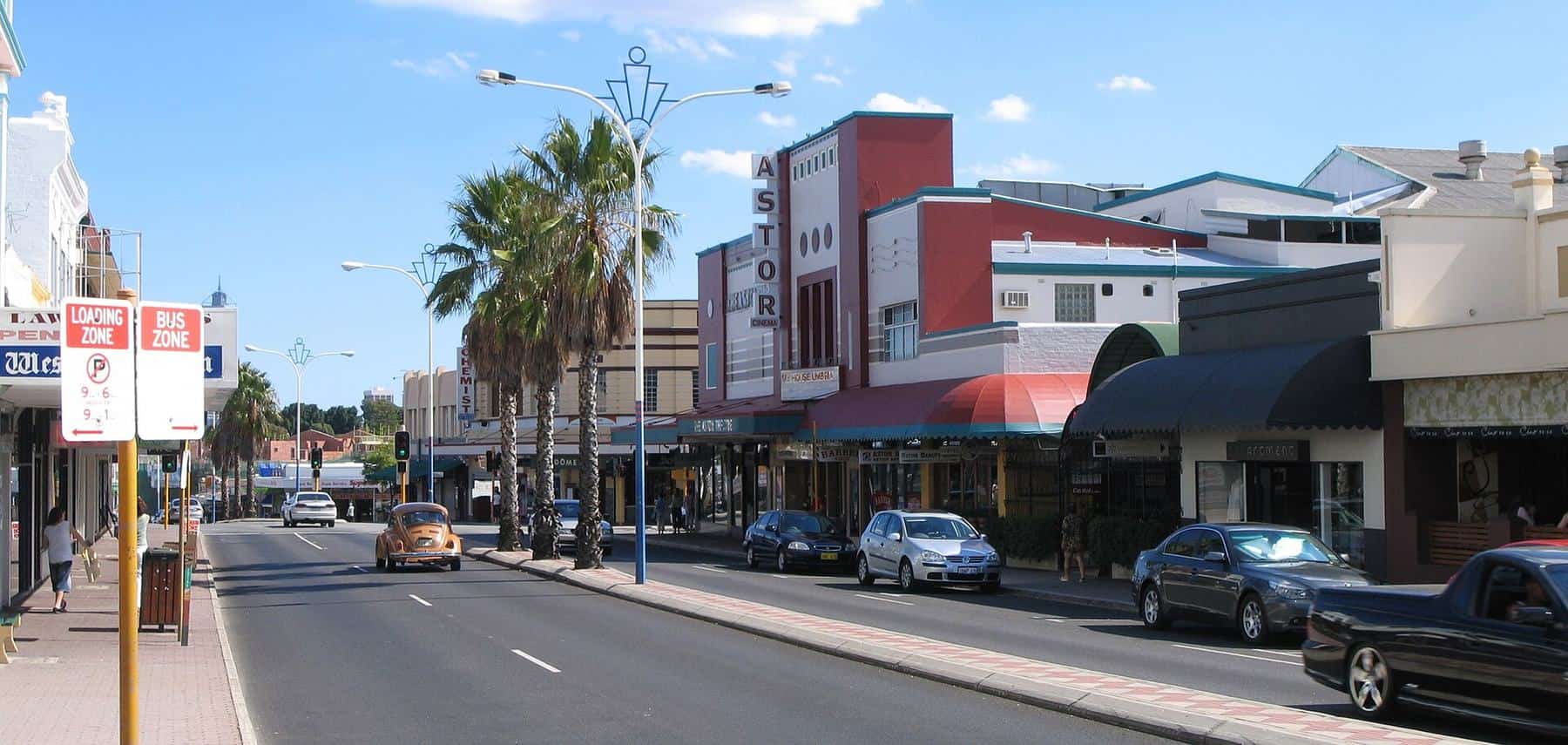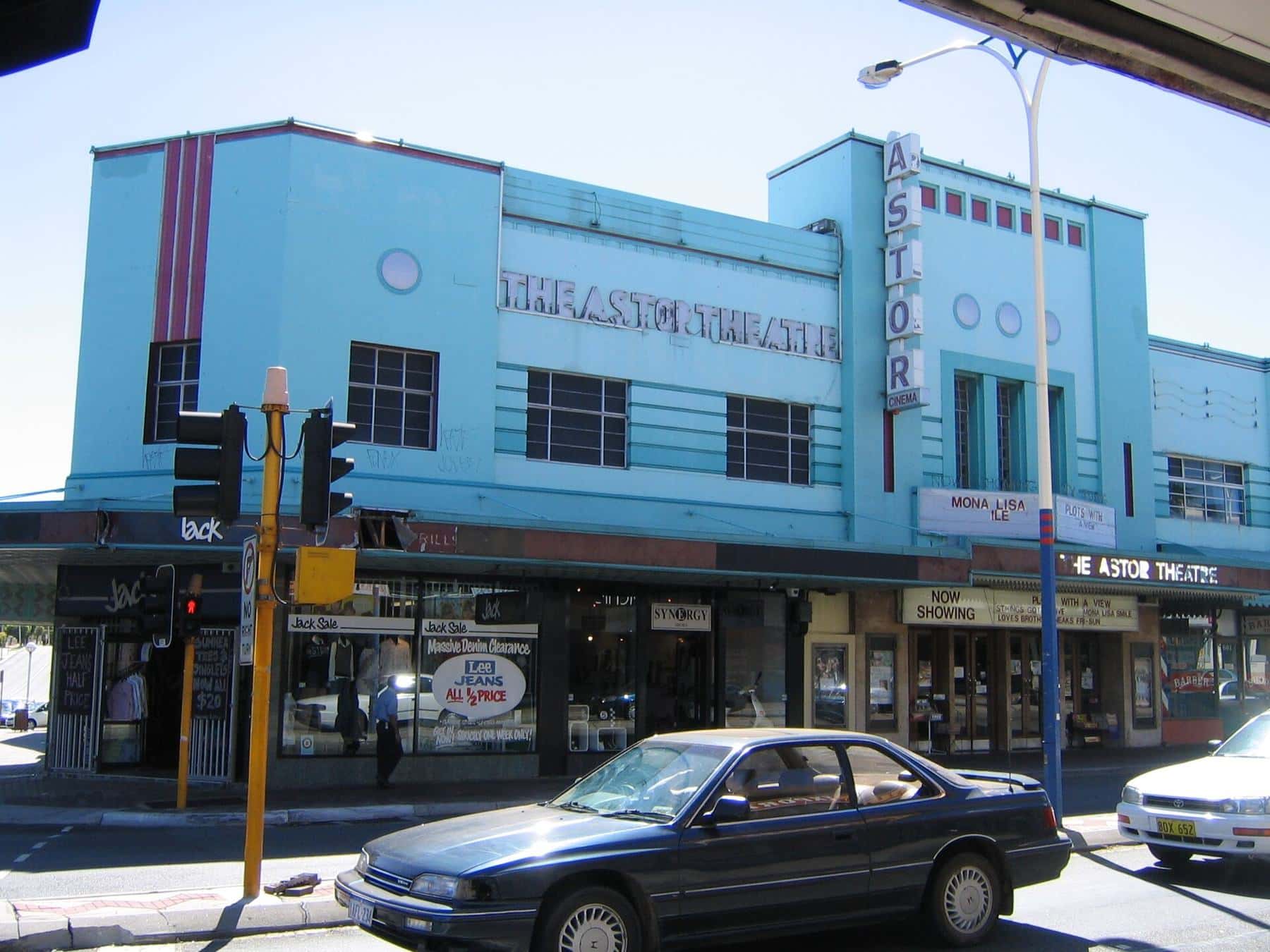
On the north-west corner of Beaufort and Walcott streets stands one of the most recognisable buildings in Perth. With its stepped parapet, vertical fins and streamlined lettering, the Astor Theatre is a textbook piece of Inter-War Art Deco. Behind that facade is a building that is even older, and a story of boom, decline and rescue that mirrors the history of Beaufort Street itself.
1914–15
Built
As the Lyceum Building
1939
Art Deco remodel
Reopened in May 1939
1999
State Register
National Trust classified 1988
The Lyceum
The tram had reached Beaufort Street by 1900, and by the 1910s the corner of Beaufort and Walcott was becoming a busy local centre. In 1911 builder Simon Bremner Alexander constructed the two-storey Broadway Building, later known as the Alexander Building, on one side of the street. Directly opposite, in 1914–15, he built the Lyceum Building, with shops, the Lyceum Theatre and an open-air picture garden. Alexander was a prominent Perth contractor who, according to the City of Vincent, also built Fremantle Railway Station and Perth Modern School.
The Lyceum showed silent films and hosted live entertainment. In 1922 it was renamed the State Theatre.
The Art Deco makeover
By the late 1930s, cinemas across Australia were being rebuilt in the streamlined Art Deco style that suited the glamour of the talkies. The theatre was remodelled and reopened on 12 May 1939, with a new facade and interior. Sources credit the design work variously to architects William Leighton and Richard Summerhayes, and the City of Vincent records that Alexander’s son refurbished the family’s Beaufort Street buildings with an Art Deco facade in the late 1930s. In 1941 the theatre took the name it still carries: the Astor.
The remodelling gave Mount Lawley its signature building and set the tone for the Art Deco flats and shops that appeared along the street in the same decade.
Decline
After the Second World War, cinema audiences fell as television arrived. The City of Vincent’s history describes the Astor of the 1950s and 60s as a run-down shadow of its former self. Next door, the Kalaf family ran the Bluebird Tearooms from 1954 to 1972. By the late 1970s and 1980s, the theatre was under threat of demolition.
Rescue and restoration
The tide turned in the late 1980s. The National Trust classified the Astor in 1988, and the building was leased and refurbished by Entrevision Cinemas, which returned it to its Art Deco glory in 1989. The restoration helped spark the revival of Beaufort Street as an entertainment precinct. On 14 May 1999, the Astor was entered on the State Register of Heritage Places.
The Astor today
The Astor has had several operators since its restoration, and its fortunes have risen and fallen with them. Today it is used for live music, comedy, film and community events. Programs and operators change, so check the venue’s own website for what’s on.
What to look for
- The corner facade. Notice the vertical fins and stepped parapet, which emphasise height, and the horizontal banding that wraps the corner.
- The lettering. The Astor name in streamlined capitals is part of the building’s identity.
- Shopfronts. The building still includes shops along Beaufort Street, continuing the original mix of uses.
- The Alexander Building opposite. Compare it with Alexander’s earlier 1911 building across the road.
- Nearby Deco. Look for the 1930s Waihemo Flats at 686 Beaufort Street and the 1934 Clarke Building at 639 Beaufort Street.
Astor visit checklist
0 of 6 done
Ticks are saved in this browser only.
The Astor and its neighbours
The Astor was not the only picture house in the area. In 1925 the Premier Theatre was built on the corner of Stirling and Bulwer streets in Highgate, with outdoor picture gardens added in 1937. The City of Vincent says it closed in 1963, was converted into an ice-skating rink and later a disco, and was demolished in 1987. The Astor’s survival, when so many suburban cinemas were lost, is a big part of why it is so valued today.
Visiting tips
- Book ahead for popular gigs and shows, which can sell out.
- Arrive early to eat on the Mount Lawley strip. Restaurants are busy before shows.
- Check accessibility with the venue before booking, as heritage buildings can have limits on access.
- Photograph the facade at dusk, when the lettering and lights stand out against the sky.
- Plan the trip home. Buses run along Beaufort Street, but late services are less frequent.
Why the Astor matters
The State Register listing recognises the Astor as a fine example of a suburban Inter-War cinema and a landmark of the Beaufort and Walcott junction. Its story also shows how a heritage building can help revive a whole street. When it reopened in 1989, the restored cinema gave people a reason to come to Mount Lawley at night, and restaurants and bars followed. Few buildings in Perth have had such a direct effect on the life of a neighbourhood.
Getting there
The Astor is at 659 Beaufort Street, Mount Lawley, on the corner of Walcott Street. Transperth buses that run along Beaufort Street stop nearby. See getting here.
A symbol of the street
The Astor’s story, built in a boom, faded with the suburbs and revived by people who valued its heritage, is Beaufort Street’s story too. Pair a visit with our Mount Lawley guide and our heritage buildings walk.
Frequently asked questions
When was the Astor Theatre built?
The building was constructed in 1914–15 by builder Simon Bremner Alexander as part of the Lyceum Building, which housed shops, the Lyceum Theatre and a picture garden.
Why is it called the Astor?
The theatre was renamed the State Theatre in 1922 and the Astor in 1941, following its 1939 Art Deco remodelling.
Is the Astor Theatre heritage-listed?
Yes. It was classified by the National Trust in 1988 and entered on the State Register of Heritage Places in 1999.
What is on at the Astor?
The Astor hosts films, live music, comedy and community events. Check the venue’s own website for current programs and tickets.
Sources and further reading
Facts on this page were checked against these primary and official sources. Conditions change — confirm before you travel or buy.
- Astor Theatre (State Register) — WA State Heritage Office — inHerit
- Astor Theatre, Perth — Wikipedia
- Mount Lawley history — City of Vincent Library & Local History Centre